Showing posts with label Traveling. Show all posts

Thursday, November 8, 2012

Hagia Sophia - Istanbul, Turkey


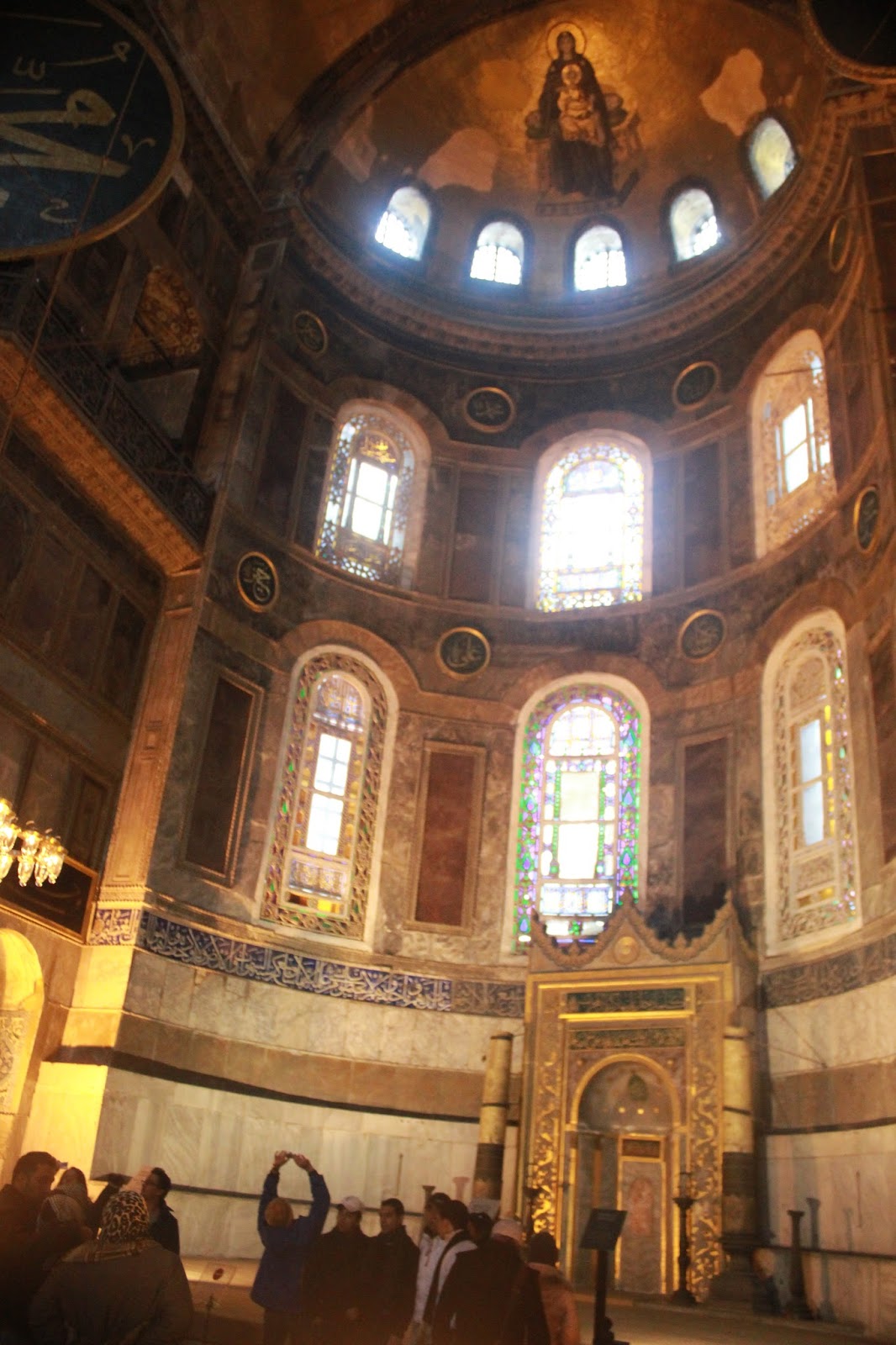
Hagia Sophia is a great architectural beauty and an important monument both for Byzantine and for Ottoman Empires. Once a church, later a mosque, and now a museum at the Turkish Republic, Hagia Sophia has always been the precious of its time.

The mystical city Istanbul hosted many civilizations since centuries, of which Byzantium and Ottoman Empires were both the most famous ones. The city today carries the characteristics of these two different cultures and surely Hagia Sophia is a perfect synthesis where one can observe both Ottoman and Byzantium effects under one great dome.

Mosque
The prophet of God in Muslim religion, Muhammad, had prophesied that the first Muslim to pray in Hagia Sophia would go to paradise. Since then, it was a great ambition for Muslim leaders to get Hagia Sophia.

On 29 May 1453, The Sultan of the Ottoman Empire, Mehmet II, conquered Constantinople after a 54 day siege. He directly went to the ancient Byzantine cathedral of Hagia Sophia. When he saw a man hacking the stones of the church and saying that this was a temple for infidels, Mehmet II ordered the looting to be stopped and the church to be converted into a mosque.

With the following years, Sultans added something to the building. Sultan Bayezid ordered a new minaret changing the previous one of his fathers’. In the 16th century, Suleiman the Magnificent brought two colossal candles from Hungary to be placed on both sides of the mihrab. To the end of the 16th century during the reign of Selim II, famous architect Sinan strengthened the building by adding structural supports to its exterior. He also built two minarets on the western end of the building and the mausoleum of Selim II to the southeast of the building. In 1600s, two mausoleums were added next to Selim II’s: Murad III and Mehmed III.

Two restorations were done in Hagia Sophia at the following years. In 1739, during the reign of Mahmud I, a medrese, a kitchen to distribute poor, and a library, and in 1740 a fountain for ritual ablutions were built.

Constantine Church
Known as the “Great Church” or “Magna Ecclesia” in Latin, the first church was built at the same location where there had been a pagan temple before. It was Constantius II who inaugurated Hagia Sophia on 15 February 360. From the chronicles of Socrates of Constantinople, we know that the church was built by the orders of Constantine the Great.

This first church was a wooden-roofed basilica with a nave flanked by two or four aisles, each carrying a gallery storey. It was preceded by an atrium. This church was largely burned down in 404 during riots since patriarch John Chrysostom was sent into exile by the Emperor Arcadius.

Architecture
Justinian’s Hagia Sophia is the one that stands today. It is an architectural intelligence and the first masterpiece in Byzantine architecture. It has been the largest cathedral for 1000 years until the Seville Cathedral was built.

The church has a rectangular shape, and the square vast square nave measuring 31m (102ft) is covered with a central dome that is carried on four pendentives. The arcade around the dome is unbroken with 40 arched windows to bring the light inside. Excluding the two narthexes and the large atrium, the basilica measures 70 x 75 m (229 x 245 ft) . The atrium measures 48 x 32 m (157 x 106 ft) and the total length of the construction measures 135 m (442 ft).

Tuesday, November 6, 2012

The Blue Mosque (Sultan Ahmet Mosque) - Istanbul, Turkey


The Blue Mosque or Sultan Ahmet Mosque was built from 1609 to 1616, during the rule of Ahmet I. Like many other mosques, it also comprises a tomb of the founder, a madrasah and a hospice. While still used as a mosque, the Sultan Ahmet Mosque has also become a popular tourist attraction. 

The design of the Sultan Ahmet Mosque is the culmination of two centuries of both Ottoman mosque and Byzantine church development. It incorporates some Byzantine elements of the neighboring Hagia Sophia with traditional Islamic architecture and is considered to be the last great mosque of the classical period. The architect has ably synthesized the ideas of his master Sinan, aiming for overwhelming size, majesty and splendour. It has 6 minarets along with 8 domes and 1 main one. At its lower levels and at every pier, the interior of the mosque is lined with more than 20,000 handmade ceramic tiles, made at Iznik (the ancient Nicaea) in more than fifty different tulip designs. The tiles at lower levels are traditional in design, while at gallery level their design becomes flamboyant with representations of flowers, fruit and cypresses. More than 20,000 tiles were made under the supervision of the Iznik master potter Kasap Haci and Baris Efendi from Avanos (Cappadocia). 

The price to be paid for each tile was fixed by the sultan's decree, while tile prices in general increased over time. The most important element in the interior of the mosque is the mihrab, which is made of finely carved and sculptured marble, with a stalactite niche and a double inscriptive panel above it. The adjacent walls are sheathed in ceramic tiles. But the many windows around it make it look less spectacular. To the right of the mihrab is the richly decorated minber, or pulpit, where the Imam stands when he is delivering his sermon at the time of noon prayer on Fridays or on holy days. The mosque has been designed so that even when it is at its most crowded, everyone in the mosque can see and hear the Imam. I must confess, this has to be one of my favorite mosque in the world!


Bosphorus - Istanbul, Turkey


The Bosphorus, also known as the Istanbul Strait is a strait that forms part of the boundary between Europe and Asia. The Bosphorus, the Sea of Marmara, and the Dardanelles strait to the southwest together form the Turkish Straits. The world's narrowest strait used for international navigation, the Bosphorus connects the Black Sea with the Sea of Marmara. It lies a number of neighborhoods each with a different character (possibly due to the fact that they all started as seperate fishing villages and some are still physically seperated from each other by lush woodlands), palaces of the late Ottoman period, and parks. This is quite easily one of the most scenic—yet largely overlooked by travellers—parts of Istanbul, which reaches its zenith during late spring, when the Judas trees, which are some sort of symbol of the Bosphorus and dotting the hills along the Bosphorus, are in full bloom of their deep-pink flowers that engulf both shores of the strait.

Wednesday, July 18, 2012

Dreamland Beach - Bali, Indonesia


Dreamland adalah sebuah pantai yang terletak di daerah bernama Pecatu, sebelah selatan Bali. Pantai ini dikelilingi oleh tebing-tebing yang menjulang tinggi dan dikelilingi batu karang lumayan besar di sekitar pantai. Lokasi pantai ini berada dalam kompleks Bali Pecatu Graha, sekitar 30menit dari Pantai Kuta. 


Pasir putih dan celah karang yang terjal menjadi pemandangan yang emang cantik banget. Berpasir putih bersih dan di bawahnya terdapat dinding karang curam membuat suasana menjadi relax and serene untuk menikmati matahari tenggelam atau sekedar liat surfer pada atraksi. Ombaknya yang tinggi dan besar banyak dinikmati oleh para penggemar surfing.


Menurut gw pantai ini worth untuk dikunjungi. Pasir nya masih putih dan air nya masih turquoise. So, memang cantik banget. Gw juga sempet body surf disini, arus nya lumayan so untuk yang pada suka surf, especially yang pemula, bisa dicoba disini. Hati-hati tapi ya, cus ada batu-batu dan karang-karang. Gw kesini exactly seminggu yang lalu, tanggal 12 July 2012. Gw kesini with my hubby for our summer holidays. We rented a car dan telusuri pantai-pantai Bali dengan GPS. And trust me, if you think Kuta, Sanur or Nusa Dua's beach udah keren, this place will change the way you think! 


The Basilica Cistern - Istanbul, Turkey


The Basilica Cistern, also known as the "Sunken Palace" or "Yerebatan sarayi" in turkish, was constructed by Justinian in 532 to supply water to the Byzantine Palace primarily. Basilica cistern or better known as Yerebatan sarayi is a very authentic place and a must see in Istanbul. I've seen it and it is one of the most amazing places I've been to.


The history to this beautiful place is that the name of this subterranean structure derives from a large public square on the First Hill of Constantinople, the Stoa Basilica, beneath which it was originally constructed. Before being converted to a cistern, a great Basilica stood in its place, built between the 3rd and 4th centuries during the Early Roman Age as a commercial, legal and artistic centre. The basilica was reconstructed by Ilius after a fire in 476.

Ancient texts indicated that the basilica contained gardens, surrounded by a colonnade and facing the Church of Hagia Sophia. According to ancient historians, Emperor Constantine built a structure that was later rebuilt and enlarged by Emperor Justinian after the Nika riots of 532, which devastated the city. Historical texts claim that 7,000 slaves were involved in the construction of the cistern. 


Today it has been completely renovated. Water still drips melancholically through the ceiling, and the brick-domed ceiling echoes classical music. This historical construction has to be one of my favourite places I've been to!

Tuesday, May 15, 2012

Turks' Burqa

Yep, this is me! And what the hell am i wearing? Burqa! The Burqa is a piece of clothing that covers a woman from head to foot. There is an opening for the eyes, but the rest of the body, except the hands, are covered. 
The burqa is usually made of light clothing, and is essentially outerwear for some Muslim women in some regions. And in my case here, it's Istanbul!
The Burqa is worn when women leave their homes, over their indoor clothes. The garment itself is a symbolic of a specific tradition and criticisms of women who wear Burqas are usually not about the garment itself, however it is about what it stands for.

Well, dare to wear girls?

Ayran

This place serves exquisite Turkish dishes at the beautiful Spice Market at Eminonu. Situated at the end of the Spice market's alley, it is definitely a great place to relax with a cup of Ayran and Kebap or just a  simple Chai (tea). To make this place more memorable, it was my first time tasting the "Ayran". Ayran (yoghurt drink) is a beverage that Turks' drink along with a Kebap. Ayran is a mixture of yoghurt, water and salt.  

This drink  has been one of the most popular drinks of the Turks since the discovery of Yogurt among the Turkish tribes in Central Asia and it is best served chilled. It not only accompanies any meal but is drunk as a refreshing drink by itself especially during summer months. It is common among all regions of the country only the slight variation being its thickness. Especially in the south, for example, thicker Ayran is preferred.
Be sure to try this unique beverage once you go to Istanbul!

Saturday, May 12, 2012

Birds of Galata

My husband took this beautiful footage of a bird that was about to fly away, along side Bosphorus, Istanbul.

Friday, May 11, 2012

Best Honeymoon Destination: Dubai or Istanbul?

Honeymooners always dream to go to a beautiful and exotic destination for their honeymoon trip. Whether it will be Europe, Asia, Africa, America or Oceania continent, honeymooners seek for romantic, picturesque and breathtaking destination for their first nights as a newlywed. Dubai and Istanbul are one of the most visited honeymoon destination amongst the Europe and United-Arab region. Dubai and Istanbul are among the most preferable honeymoon destination. Although, Dubai and Istanbul are among the most preferable honeymoon destination, Istanbul should be the one if you are looking for an unforgettable experience.
As one of the few main reason that a honeymooners would reconsider to come to that destination would be accommodation. Accommodation is the supplies we need in order to feel complete in the chosen destination. Hotels, airport chauffeur, food and sight-seeing tours are just one of the accommodations a honeymooner seeks. Dubai is one of the most expensive and consumptive people in the united-Arab region, thus the accommodations are much costly than Istanbul. A three star hotel in Dubai can cost you a whopping of $180, while in Istanbul a three star hotel only cost $60. This goes for the food as well. A lamb kebab in Dubai cost $8, while in Istanbul it will only cost you $2. Overall, the accommodation is Dubai is far more expensive than Istanbul, thus Istanbul would be the choice for accommodation-wise.


Culture and society heritages are also one of a honeymooner consideration in choosing the perfect destination.  Honeymooners seek for people and places that would dent their honeymoon experience. Both Dubai and Istanbul are filled with the Arabic heritage. However, which has the most interest for the honeymooners?  Istanbul was once ruled by Persians, thus the ethnicity are purely Arabian. While Dubai was actually once a dessert with little villages throughout the extensive golden sand. Therefore, Istanbul has more pure tradition and customs due to their history and narration.
Through all the contemplation for honeymooners, the last would be the popular landmarks. Popular landmark is the signature or milestone from the country or city. The landmark attraction goes not only for honeymooners but also travelers and backpackers.  For instance, Istanbul has the beautiful and admired Blue Mosque. While, Dubai is acknowledge with their Burj Khalifah. Burj Khalifah is the tallest building in the world. Along with, Blue Mosque as one of the oldest mosque in the Europe world. Without a doubt, both have their selling point. Hence, which country has more magnetism to the honeymooners?
Istanbul and Dubai has their own plus and minuses. Dubai is renown with their futuristic features. While Istanbul recognition’s would be the old and beautiful city. Adding the accommodation, culture and popular landmarks, Istanbul is definitely the best destination for honeymooners.